Silicone is one of the finest electrical insulators in existence. Volume resistivity of the order of 10\u00b9\u2074 \u03a9\u00b7cm, dielectric strength exceeding 20 kV/mm. Precisely the opposite of what is needed when the objective is to dissipate an electrostatic charge or maintain electrical continuity between two surfaces.
Conductive silicone exists to resolve that contradiction. Carbon fillers are incorporated into the polymer matrix during formulation, and those particles create electrical conduction pathways throughout the entire volume of the material. The result is an elastomer that retains the useful properties of silicone \u2014 flexibility, thermal range of \u201340 to +200 \u00b0C, chemical inertness, compressibility \u2014 but with an electrical resistivity several orders of magnitude lower than standard silicone.
That does not make it a conductor. It makes it a material with sufficient conductivity for certain applications and wholly insufficient for others. Knowing where that boundary lies is the difference between a correct specification and one that will cause problems.
What carbon does inside the silicone
Carbon particles dispersed in the silicone matrix form a network of inter-particle contacts. When the filler concentration exceeds a critical threshold \u2014 the percolation threshold \u2014 those contacts create continuous electrical conduction pathways through the material. Below that threshold, the silicone remains insulating even though it contains carbon.
The important point about this mechanism is that the conductivity is volumetric. It does not depend on a surface layer, a coating or a treatment. If the sheet is cut, the exposed cross-section is just as conductive as the original surface. If it is compressed, the conduction pathways are maintained or even slightly improved as the particles move closer together. If it wears in service, the property is not lost.
This is a fundamental difference from surface-based solutions \u2014 conductive paints, vacuum metallisation, nickel coatings \u2014 which degrade over time, with abrasion and with flexing.
The trade-off is that the carbon loading penalises the mechanical properties. A standard 65 Shore A silicone can achieve 8\u20139 MPa tensile strength and 25\u201330 kN/m tear strength. The same hardness loaded with carbon delivers around 5.5 MPa and 15 kN/m. These are perfectly functional values for gaskets, pads and linings, but they must be taken into account if the part will operate under significant mechanical stress.
And the colour is black. Always. There is no alternative. The carbon that provides the conductivity also provides the colour, and it cannot be changed without changing the electrical property.
Where it works and where it does not
The typical surface resistivity of a carbon-loaded conductive silicone sheet is of the order of 10\u00b2 \u03a9/\u25a1 (ohms per square). The volume resistivity typically lies between 10\u00b9 and 10\u00b2 \u03a9\u00b7cm, depending on formulation and filler loading.
Those numbers define precisely what it is suitable for and what it is not.
ESD protection
Most ESD standards (IEC 61340, ANSI/ESD S20.20) require that work surfaces and materials in contact with sensitive components have a surface resistivity of less than 10\u2076 \u03a9. Conductive silicone is several orders of magnitude below that threshold.
It dissipates electrostatic charges in a controlled manner without generating abrupt discharges that damage components. Workstation mats, transport tray linings, test station bases \u2014 all of these work correctly.
Low-demand earthing
Interface contacts between metallic components that require electrical continuity without a rigid connection. The flexibility of the silicone absorbs mounting tolerances, thermal expansion and vibration, maintaining contact where a rigid conductor would lose it.
It is not a power conductor \u2014 it is a low-resistance path for draining charges or maintaining equipotentiality.
Dual-function gaskets
When a gasket needs to seal mechanically whilst simultaneously providing electrical continuity between the surfaces it joins. Electronic equipment enclosures, junction boxes with earthing requirements, interfaces between shields.
The compressibility of the silicone allows it to conform to surface irregularities whilst the carbon filler maintains the electrical pathway.
ATEX environments
In potentially explosive atmospheres, any non-conductive surface can accumulate sufficient electrostatic charge to generate a spark discharge. Conductive silicone dissipates that charge continuously. Its thermal range of \u201340 to +200 \u00b0C makes it compatible with the majority of industrial environments where ATEX regulations apply.
Suitability in an ATEX zone depends on the complete system design and effective electrical continuity with the earthed structure.
EMI shielding
It does not work for serious EMI shielding. The electromagnetic attenuation provided by a carbon-loaded silicone sheet is limited \u2014 of the order of 10\u201320 dB at low frequencies, and decreasing at higher frequencies.
For effective shielding in the GHz range, metallic fillers (silver, nickel, copper-silver) or embedded metal mesh are required, offering attenuations of 60\u2013100 dB. If the requirement is to meet MIL-DTL-83528 or attenuation levels exceeding 40 dB, carbon-filled silicone is not the solution.
In such cases, carbon-loaded silicone can be used as an electrical continuity gasket, but not as the primary shielding element.
Power conduction
It does not work as a power conductor. A resistivity of 10\u00b9\u201310\u00b2 \u03a9\u00b7cm is several orders of magnitude higher than any metal. For transporting current with energy efficiency, this silicone is not an option. Its function is to dissipate static charge and maintain low-current continuity, not to replace a cable.
Sheet vs. extrusion: two formats, one material
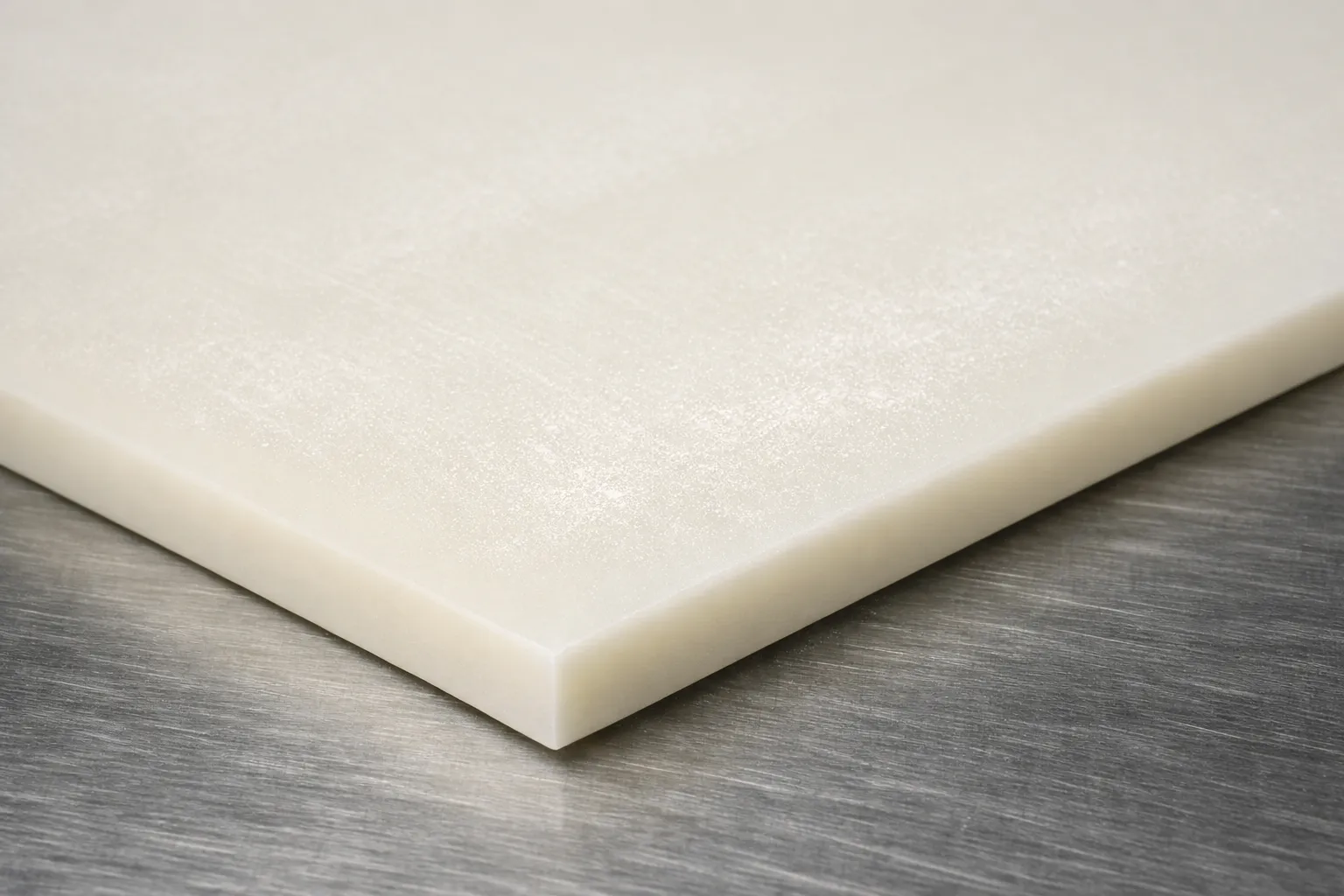
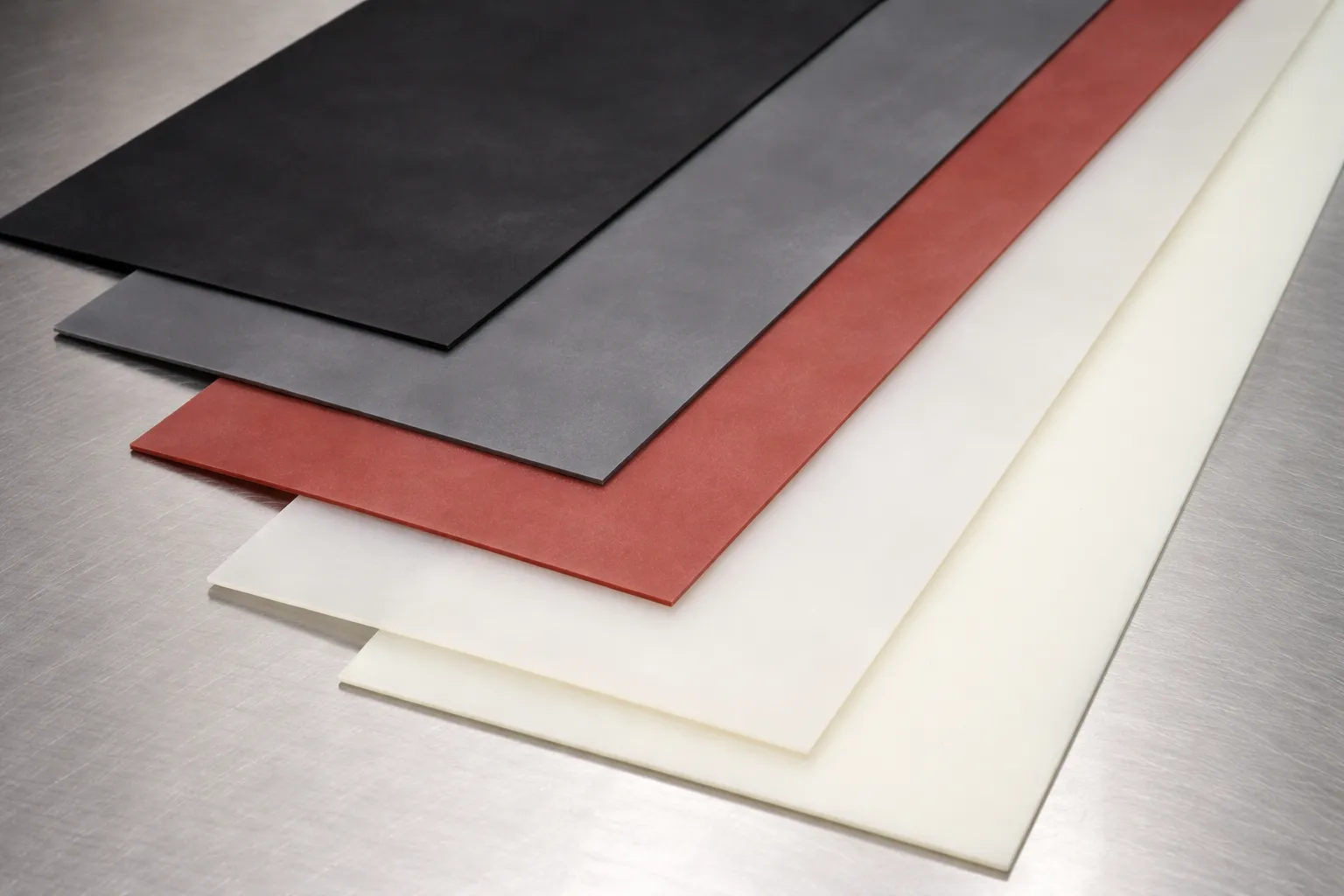
Conductive silicone sheet is the most versatile format for flat applications: gaskets die-cut to drawing, workstation mats, linings, contact pads. Common thicknesses from 0.3 to 10 mm, in standard roll formats. It is cut with a blade, die-cut with conventional tooling and fitted directly.

Conductive Silicone Sheet
Carbon-loaded silicone sheet for ESD protection, grounding and low-intensity conduction. 65 Shore A, 0.3–10 mm thickness.
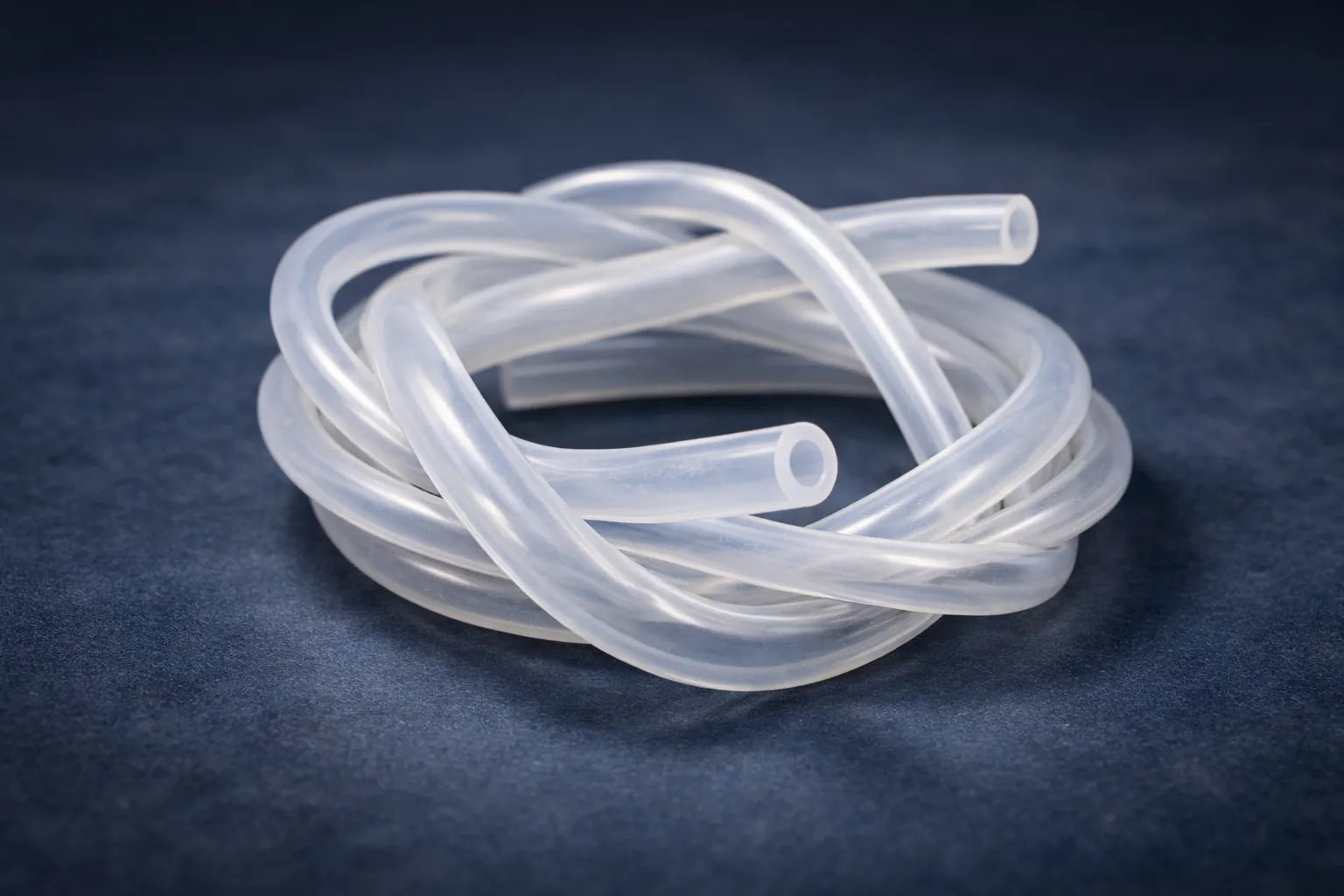
View product →For geometries that cannot be achieved with flat sheet \u2014 conductive tubes, complex-section profiles, cords, shaped gaskets \u2014 the same type of compound is formulated for extrusion, with volume resistivities in the same order of magnitude depending on formulation.
The format changes; the electrical principle remains the same. The choice between sheet and extrusion is determined by the part geometry, not the electrical requirement.
A clear hierarchy
In practical terms, the hierarchy is straightforward:
- Standard silicone \u2192 insulating (\u224810\u00b9\u2074 \u03a9\u00b7cm).
- Carbon-loaded conductive silicone \u2192 dissipative (\u224810\u00b9\u201310\u00b2 \u03a9\u00b7cm).
- Metal-particle silicone \u2192 highly conductive, intended for demanding EMI applications.
Each addresses a different problem. Confusing them is a specification error.
What needs to be specified
Four data points define a conductive silicone part:
The thickness, which determines compressibility, mechanical stiffness and dimensional tolerance. A contact pad in a compact electronic enclosure may require 0.5\u20131.0 mm. An ESD workstation mat may work at 3 mm. An anti-vibration mount with earthing may need 6\u201310 mm.
The part geometry: full roll for on-site cutting, rectangular cut for straightforward applications, die-cut to drawing for gaskets, washers or specific profiles.
The actual electrical requirement: ESD protection, earthing continuity or EMI attenuation. If ESD or basic electrical continuity, carbon-filled silicone meets the requirement. If demanding EMI, the frequency and attenuation level must be defined before selecting the material.
And the operating environment: temperature, chemical agents, permanent or cyclic compression, UV exposure. Conductive silicone maintains its electrical and mechanical properties between \u201340 and +200 \u00b0C. Outside that range, mechanical properties may degrade even though conductivity is maintained.
The rest is geometry and thickness.
Need conductive silicone sheet or die-cut parts to drawing?
Tell us the thickness, dimensions and the electrical requirement for your application.
Request quotation →